
Updates
Plena Health.
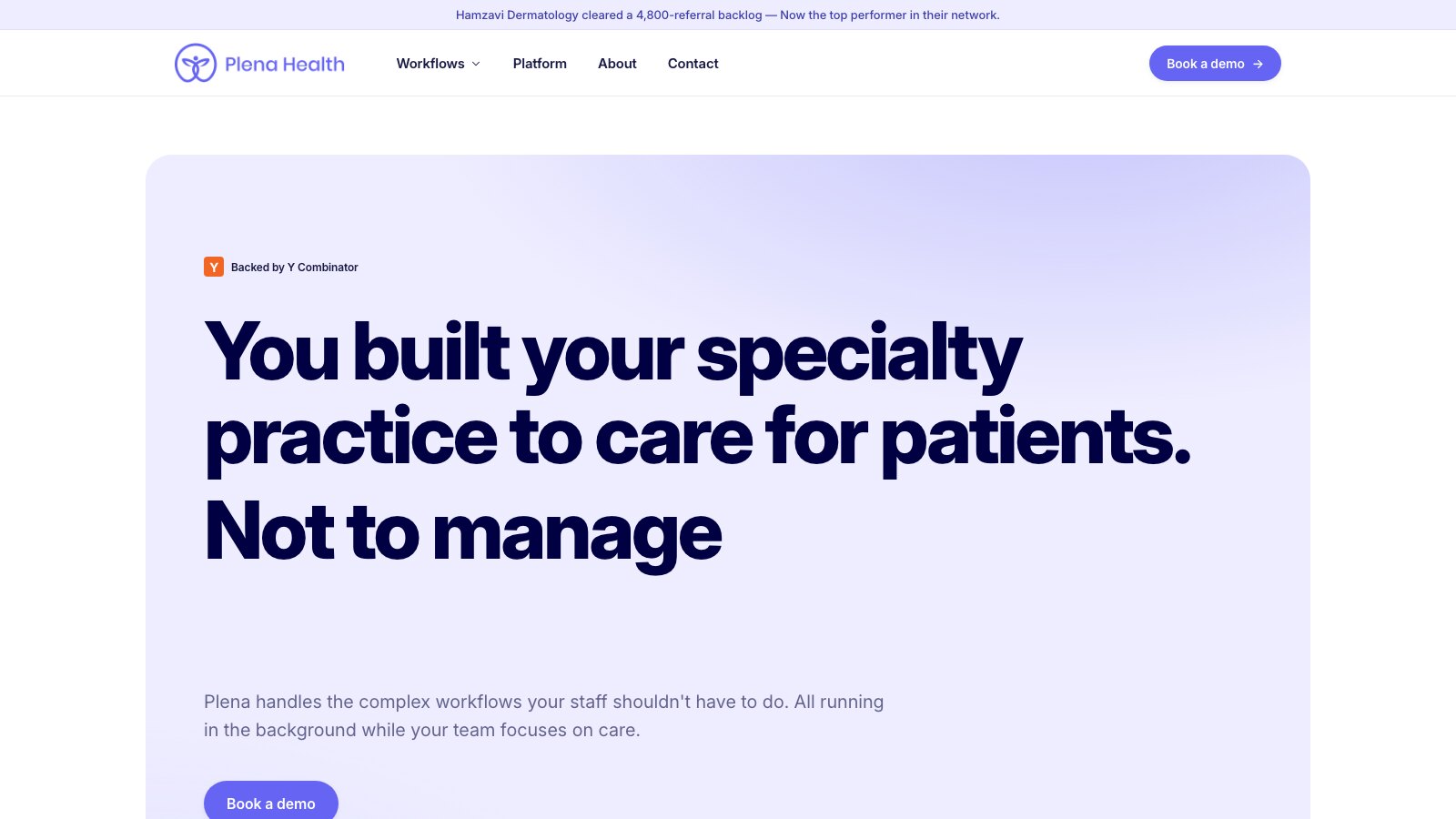
Plena Health builds the AI operating system for specialty medical practices. The company automates the administrative workflows that keep clinics running: referrals, fax intake, scheduling, procedure compliance, records, prior authorizations, billing, and collections. It is aimed at the work around the medicine rather than the medicine itself.
The important architectural choice is that Plena does not ask practices to rip out the systems they already use. It runs across EHRs, faxes, phones, clearinghouses, payer portals, and patient communication tools, taking over the rote work end to end while leaving the practice's existing stack in place.
What they're building
Specialty practices are operationally dense. A single referral can mean reading a fax, matching a patient, extracting clinical details, checking insurance, updating the EHR, attaching documents, routing tasks, and chasing missing information. Multiply that across dozens of workflows every day and the clinic becomes a system of people manually bridging software that was never built to talk to itself.
Plena's answer is a base platform of reusable workflow primitives, integrations, and agent harnesses that can be assembled around each practice. Customers can start with one painful workflow, such as referrals, collections, or scheduling, and expand as the system proves itself. That is the wedge: do the work, then become the operating layer.
Why we backed the founders and team
We like companies that choose the ugly, operationally real version of a market. Healthcare AI is full of demos. Plena is focused on the back office: faxes, portals, phone calls, insurance checks, and the exact handoffs that decide whether a clinic runs smoothly. Those are not glamorous workflows, but they are where labor, revenue, and patient access actually get stuck.
Eyad and Ahmed grew up around medicine and then built in serious engineering environments: Datadog, Shopify, AWS, and nuclear systems. That combination matters. Selling into specialty practices requires empathy for clinical operations, and building the product requires infrastructure that does not fall over. Plena is taking on both.