
Updates
Volantis.
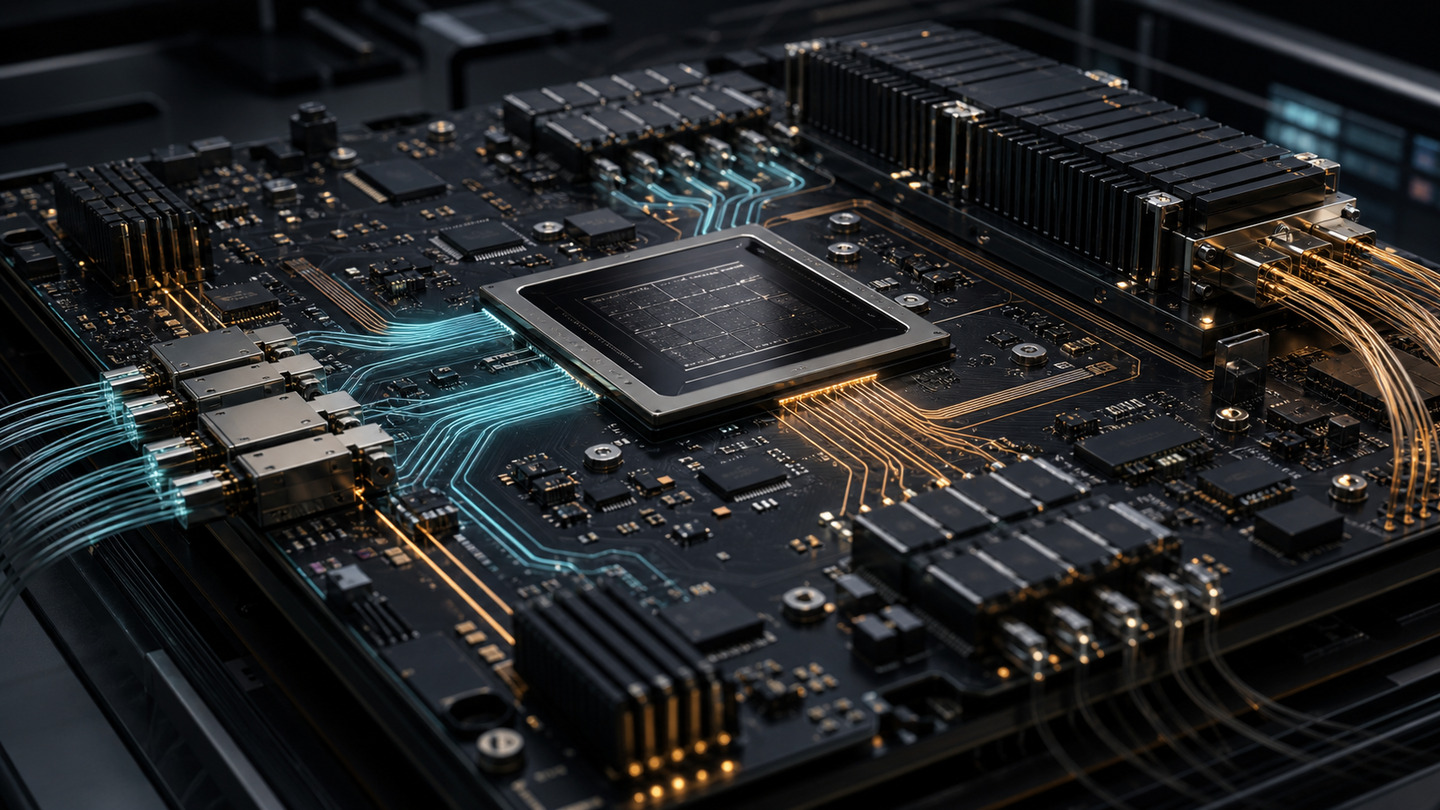
Volantis builds photonic interconnect for AI compute. Its product is a photonic motherboard, a board that moves data between chips as light, through waveguides integrated into the board itself rather than copper traces or fiber-optic cable. The premise is simple, and the company states it plainly: the problem is moving information rather than processing it.
Modern AI clusters are bound by communication. Accelerators sit idle while weights and activations cross electrical links that have not kept pace with the chips they connect. Volantis, founded by Tapa Ghosh, is going at that bottleneck directly. The team has led fifteen idea-to-silicon tapeouts in photonic chip manufacturing, and the company's backers include Sam Altman and Alex Wang.
What they're building
The photonic motherboard departs from conventional silicon photonics in two ways. It uses direct modulation, and it uses waveguides in place of fiber. Dropping fiber removes the bulky optical channels that limited density in earlier optical systems. Volantis says the result is one hundred times the optical wire density of fiber-based designs and ten to one hundred times more bandwidth. The company also measures inference at fifteen times faster per dollar than Nvidia B100s.
The system is built to scale out. A deployment can connect up to 400 nodes with up to 24 terabytes of memory, which matters for serving large models, where memory capacity and interconnect latency set the ceiling. The company's published roadmap puts pre-orders in the first quarter of 2026 and launch in the second.
Why we backed the founders and team
Photonics has been the right answer on paper for decades. Physics favors light for communication; the obstacle has always been manufacturing. Modulators have to yield and packaging has to survive. The channels need to be dense enough to be worth the trouble. That gap between the physics and the product is the terrain we look for. It does not demo well. The work is tapeouts, test structures, and thermal budgets, repeated until the board works.
If Volantis is right, the unit of AI compute stops being the chip and becomes the board, accelerators and memory and light assembled into one system. That is an assembly problem as much as a silicon problem, and it sits at the center of our thesis. The hard frontier goes to teams willing to build through the long middle. Volantis is doing that work now, in hardware and on a schedule.